
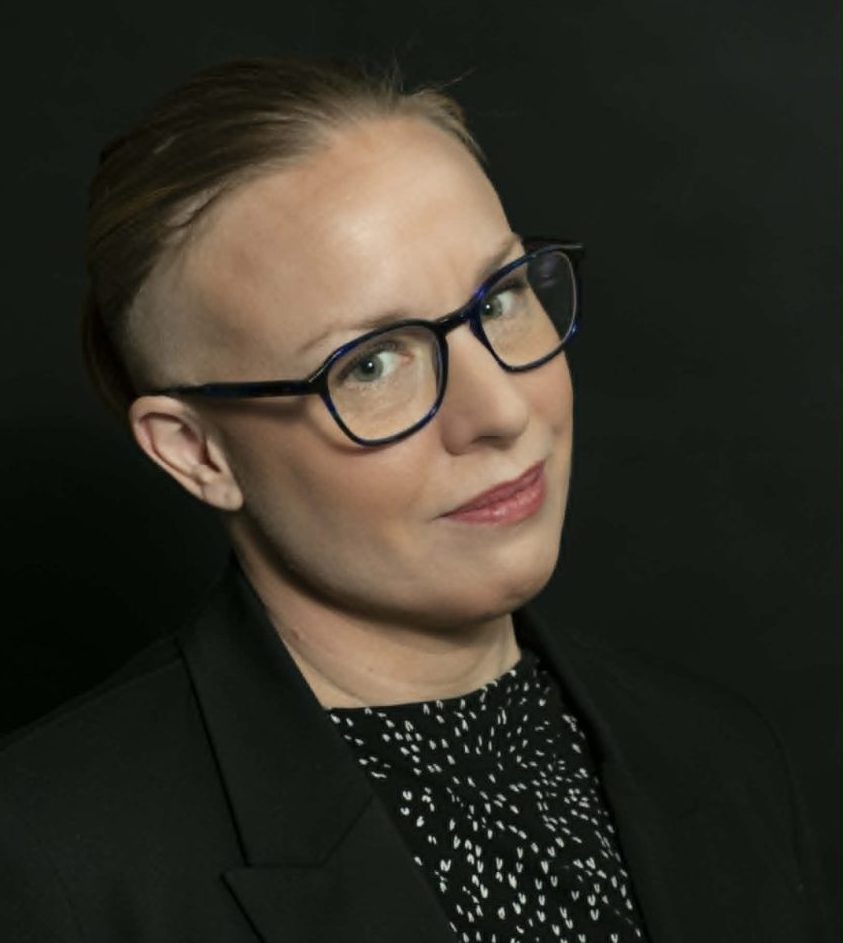
29 Apr Interview with Karmen McNamara, Director for “The Landlord’s Game.”
This week, we caught up with director Karmen McNamara. This year, they are directing The Landlord’s Game, the story of Lizzie Magie, creator of the titular board game. We talked about their history with theatre, what kinds of theatre excites them as both a director and audience member, and what sort of unique opportunities a festival like this affords them.
Can you introduce yourself and share how your love of theatre began?
Karmen McNamara:
Hi there, I’m Karmen McNamara, calling from the traditional territory of the Lekwungen-speaking peoples. I’ve been onstage, or involved in theatre, pretty much my entire life.
I grew up in Red Deer, Alberta, which at one point had the reputation of being the most “redneck” city in Canada. As a child, I really wanted to play hockey. I was a girl, so my parents, trying as hard as they might, put me in ballet, which meant that I was on stage from the time that I was three, and just developed a love for being on stage. I’m still terribly uncoordinated, no matter how they tried, but they tried.
I did my first play when I was five, and then was very fortunate from the time I was nine to get involved with a youth theatre company that was actually run out of Red Deer College. For anyone who was familiar with theatre in Canada, in the 80s and 90s, there was a period of time where Red Deer College had one of the top acting programs in the country, and there were just some amazing people that came out of there. Tara Beagan, a really well known playwright, was a few years older than me, and I did a lot of work with her, and her brother, Patrick. It’s very fortunate to have a start being trained by these amazing professors at the age of nine, and then I was just doing theatre with them and in school all the way through after graduating high school, I went and I did my two years in acting there, and one of the things that came out of that program that I was very grateful for was my love of directing.
I’d never really had the opportunity to direct until I started my acting training. So then I went on and I finished my degree in directing at the University of Saskatchewan, and then after that, moved back to Calgary, where I did a lot of work in mostly directing and stage management, a little bit of acting. There I was there for about 10 years, working with a variety of companies. I ran my own company for a couple of years, and then in 2014 my partner and I moved out to Victoria, which was immediately home from the time we arrived- it’s very much where I was meant to be.
There were a number of things happening with both my family and in my partner’s family: between 2014 and after covid, in terms of just a lot of family illnesses, deaths, etc. That just kind of kept me from doing theatre as I was focusing on my family, but then I strongly got back into it a couple of years ago, and have just haven’t looked back. I’m so excited at how much theatre there is in Victoria, how much the scene seems to be thriving, and there’s some new and innovative things that are happening. And just grateful to be becoming part of this community.
Have you noticed trends in theatre across different places or over time in Canada?
Karmen:
It’s very interesting. In my youth, the majority of my training in my childhood and through high school was in musical theatre. That’s what tended to be popular in Alberta and in Red Deer. That’s what was getting funding, so that’s what people did. So I had a lot of training in musical theatre once I got into college and university. and then I did some training as well at Playhouse North when I was in Calgary, and the focus really became on developing your own theatre, because that’s what people would do.
As anyone who has ever auditioned for anything knows it is incredibly difficult to break into the community, regardless of talent. And so people were starting to get work by making their own theatre. From there I think things were starting to get a little bit more interesting and looking into our own lives more, because we write what we know. I’d say the last 10 to 15 years have been more focused on these personal stories, and I’m really enjoying the connections between the actors.
One show that I’ve been working on as a director and producer for the last two and a half years was written by a Ukrainian refugee about their experience, and so I’ve seen that show has now been mounted four times. We’re putting it up again in August as our fifth run, and it is performed entirely by Ukrainian refugees, so really tapping into them telling their own stories in ways that hopefully other people can connect with, but bringing out that lived experience.
What role does empathy play in live theatre?
Karmen:
I think that theatre, more than any other medium, has the capacity to allow us to really see and feel inside somebody else’s experience. I was fortunate to see Casey and Diana at the Belfry on Friday evening, and that’s a period of Canadian history that I knew in a sort of academic way, but it’s not something that I personally experienced, because when I was growing up, was about 10 years later, and the treatment rates were just much more developed by the time I was learning about it.
And so it was the first time that I really had the opportunity to feel what it must have been like to suddenly lose dozens of your friends to this mysterious illness that nobody understood and were terrified. And I was surprised at my own emotional reactions to a topic that I thought I knew a fair amount about, and then realizing that while I knew it, academically, I didn’t understand it, and that that show really allowed me to feel that experience.
And I believe that the best theatre allows us to feel somebody else’s experience in a way that, for example, film often doesn’t because it’s on a screen, and it’s easier to detach. Film is its own wonderful medium, and it can certainly see things that theatre can’t, but I think you’re absolutely right that there is a type of empathy that comes out through that guttural reaction to a person in front of us experiencing something that we can’t look away from.
How did you come to direct The Landlord’s Game, and what drew you to it?
Karmen:
I am super excited about this piece! The way it came about was kind of funny. I got an email a couple of weeks ago from Sean, the playwright, whom I had never met and had no connection with, saying, ‘Hey, would you direct my show?’ ‘Okay, send me the script and I’ll take a look at it.’ And from the second I read it, I was just absolutely floored at the quality of the writing, and I found myself laughing out loud and really connecting with these characters who are, on one hand, hilariously ridiculous, and on the other hand, are going through a tragic story.
And I was really excited, firstly, the writing was so good and so crisp, but then actually, Lizzie Magie’s story. I think it is often a story that has been lost to history, and unfortunately that is the case for a lot of women who have made a difference in history, is that either their inventions are attributed to men, or the stories are just simply never told.
The story of Prosperity, which was the partner game to Monopoly, that was there from the very beginning, is something that very few people know even existed. The reason the games were invented were in fact in order to demonstrate the idea of of prosperity and redistribution and the fact that we’ve lost that, I think, really speaks to something about the way that women and their role was viewed in in 1904 but also, unfortunately, in some ways, is still viewed today.
What are the challenges and opportunities of directing a one-act play?
Karmen:
I am just incredibly grateful for the caliber of the team that we have here, both the cast and the designer and the playwright, of course, are just top notch. We’ve been in rehearsals for about a week and a half, and I am completely floored at what the actors have come up with. And so I think certainly we are not lacking in terms of rehearsal time and putting this together for what the show is in the time that there is, I think that we are in a very strong position, and that’s just due to the sheer talent of the actors, so props to them.
One of the really neat things that we’re able to do with this show, because it is a one and done, and without giving too much away, is we have the opportunity to destroy our set and it’s something that plays into the story of the show, and there are certain pieces of destruction that are hinted at within the writing and that work well within what Sean has written. But then with a designer, I started talking more and more about what we wanted to do and how we were going to do this in a festival environment, realizing that, unlike in a run where you have two or three weeks or two months or whatever, and you have to ensure that all of your props and set pieces can withstand that length of a run, or at least are cheaply replaceable, we have the opportunity to just completely destroy it over the course of the show and that works with what we’re doing. So I am really excited about that, because that’s something you would not often get to do.
Are there local artists or companies you’re excited about right now?
Karmen:
My favorite company in Victoria, and has been for a long time, is Theatre Inconnu. We’ve had season tickets as long as we’ve been here, and I love the rawness of all of their works. I would say that more than any other company in the city, it is the one where I know that I go to a show and I’m going to come away reflecting on something. They really consistently put together high quality work on almost no budget, and I’ve been very fortunate to have been in one of their shows.
And then I’m in Kintsugi, which is going up in October, so I’m super excited to work with them again. With the One Act Play Festival, I just love seeing the work of young artists. There’s a lot of young artists involved in the festival. I’m a little bit older. I’m not one of them, but the talent that’s coming up in Victoria is just incredible. So I’m super excited to see to see these shows.
As a director, what do you hope to bring to this piece—and what do you hope audiences take away?
Karmen:
As a director, I see my role in this show as facilitating the rest of the team and bringing out their best work. So again, I just can’t speak highly enough of this team. Lexi as a designer, is just incredible. And the actors, in terms of their acting, and then Helen in terms of her singing, are just bringing some top notch work. If I can allow each of these people to shine in the way that they do best, I think I will have done my job.
In terms of what I want the audience to take away. I would really like the audience to come away having learned something about how we treat other people and how we value other people. That can seem benign. For example, if I’m business person, my job is to make money for my shareholders, that in some circles, is considered a fairly benign statement how that plays out in reality, and the impact that that has on people’s lives, and what assumptions that we make about how the world around us functions. In 1904 the idea that a woman would be self supporting and make her own living was very bizarre. It didn’t fit within the accepted norms of society. And so I would ask the question, what accepted norms of society do we have that are not serving us?
Why is this story important to tell today?
Karmen:
I think it’s important to identify what some people would call rules, some people would call norms, some people would call mores. I also have a degree in sociology, so recognizing that these are slightly different from what we may say at an academic level.
When it comes to our everyday lives, what are the unspoken rules that we follow in order to fit in in our society? That doesn’t mean that we necessarily disregard them. For example, I don’t think that holding the door open for somebody as you’re as they’re going through the door is something that we want to get rid of, but I think it’s important to be able to identify using that as an example. Why am I holding the door for this person? And is it making the world better or worse? And that allows us to make more informed decisions about what we do, as opposed to just acting on autopilot.
Final question: It’s very late, you’re heading home after night 6 of an 8 evening run, and you stop at a gas station. You need something sweet, something salty, and a drink – what do you get?
Karmen:
Okay, so for something sweet, I would get some sort of sour gummy candies. Definitely love those. I’m not much for salty snacks, so I would ask the person sitting next to me in the car what they wanted. For something to drink, assuming that I am indeed super tired, if I need to stay awake and need to keep going, I’m getting a Coca-Cola because that is absolutely my magic. If I am going home to bed, it would be basically anything without caffeine.
Catch The Landlord’s Game at the Between Words One Act Play Festival, this June